Dejah Thoris’s captivity
A Princess of MarsDejah Thoris’s captivity is a recurring political and personal crisis that carries her from Thark to Zodanga. In both places, her confinement exposes the conflict between her own agency and the plans imposed by rival rulers; her rescue from the Tharks succeeds, while her imprisonment in Zodanga becomes entangled with a proposed marriage and a possible peace between Helium and Zodanga.
Capture and arrival at Thark
Dejah Thoris enters the Thark community as one of two captives brought back with a returning expedition. Their arrival in the central plaza draws more attention than the customary greetings exchanged among the warriors and women. She and John Carter become the focus of questioning, then are assigned separate quarters in the city. The scene establishes her captivity not as an isolated misfortune but as part of the Tharks’ power over outsiders brought into their territory.
The danger becomes explicit when Sola reports that Sarkoja has gone before Tal Hajus and that there is little hope for either captive. According to what Sola has heard in the plaza, Dejah Thoris and Carter are to be thrown to the wild calots in the great arena once the hordes assemble for the yearly games. This threatened fate gives their imprisonment a deadline: the games are not merely a public gathering but the occasion on which the captives may be killed.
Tal Hajus and the failed escape
Carter later discovers that a chieftain has ordered four warriors to seize him if he returns to Dejah Thoris’s chamber. They are to disarm and bind him, take him to the vaults beneath the jeddak’s quarters, and keep him there until Tal Hajus wants him. The order also states that Dejah Thoris is already safe in Tal Hajus’s hands. Her captivity has thus become part of the ruler’s direct control, while Carter himself is to be removed from the possibility of intervening.
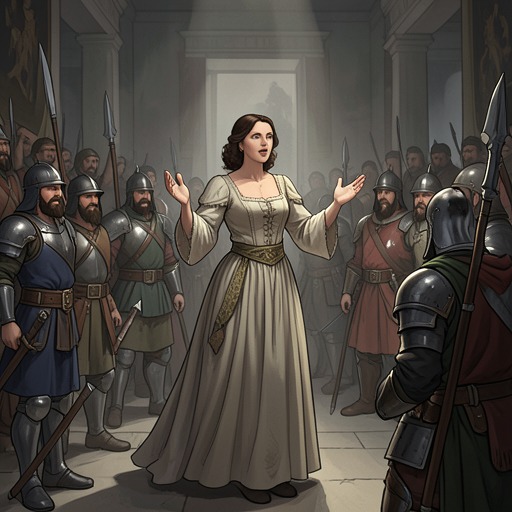
From a hidden position, Carter sees Dejah Thoris and Sola brought before Tal Hajus. Dejah Thoris stands upright and meets the ruler without visible fear, despite the hostility of the gathering. Tal Hajus dismisses the others, then announces that he intends to make her his captive before subjecting her to further cruelty. Carter intervenes when Tal Hajus takes her by the arm. Although he has a sword in hand, Carter does not strike the Thark ruler: he remembers Tars Tarkas and refrains from taking from him the moment he has long awaited. Instead, Carter knocks Tal Hajus down and leads Dejah Thoris and Sola away.
Their escape depends on speed and a route chosen to avoid detection. Carter lowers Sola and Dejah Thoris from a rear window using straps and leather from his equipment. They cross the courtyard in the shadows, reach the thoats he had left behind, and ride out of Thark. Rather than take the nearby waterway, they travel northeast across the waste toward another route to Helium, a journey of two hundred dangerous miles. The rescue ends Dejah Thoris’s immediate captivity among the Tharks, but it does not secure her freedom for long.
Imprisonment in Zodanga
In Zodanga, Dejah Thoris is held under a different political arrangement. Kantos Kan tells Carter that Sab Than has concealed her in the city and has fallen in love with her. Than Kosis, Sab Than’s father and the jeddak of Zodanga, has made her voluntary marriage to his son the price of peace between Zodanga and Helium. Tardos Mors refuses to accept that demand, declaring that he would rather see his granddaughter dead than married to someone she has not chosen. Her confinement therefore connects personal liberty to an international negotiation: she is both a prisoner and the proposed instrument of a treaty.
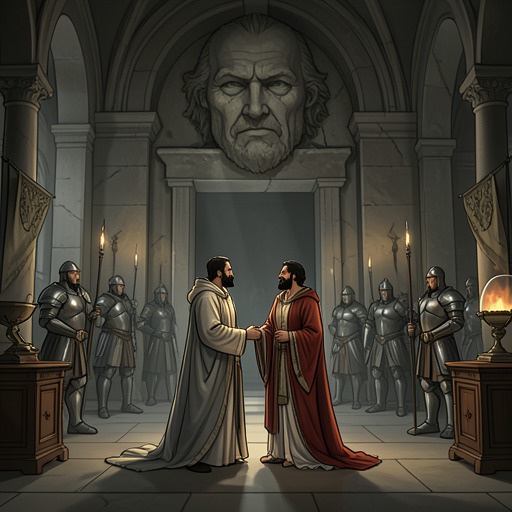
Carter encounters the situation while assigned to guard Than Kosis from concealment behind the room’s tapestries. Dejah Thoris arrives with four soldiers of the Guard and approaches the ruler with Sab Than. Her presence is unexpected to Carter, who has been told she is imprisoned, and her meeting with the two Zodangan rulers becomes the visible center of a negotiation over peace. After speaking with Than Kosis, she leaves the apartment still accompanied by her guards. The scene does not explain her reasons for appearing or establish that she is free to come and go; it shows her within the guarded political setting where the proposed marriage is being discussed.
Captivity, choice, and political power
The two episodes differ in their immediate threats. At Thark, the reported plan is to kill the captives at the yearly games, and Tal Hajus’s attempt to keep Dejah Thoris under his personal control prompts Carter’s rescue. In Zodanga, the evidence centers on her confinement and the demand that she marry Sab Than as the condition for peace. The first captivity ends in flight; the second places her at the center of a negotiation whose outcome remains unresolved in the cited scenes.
Across both settings, Dejah Thoris is not merely a prize passed between rival rulers. At Thark, she speaks to the assembled warriors in support of peaceful relations and urges them to join the red people in efforts to sustain Mars; the account presents her appeal as having moved the listeners, though no lasting change follows from it there. In Zodanga, the word voluntary in the proposed marriage matters precisely because the arrangement is imposed as a political price. Her captivity thus reveals the tension between the choices claimed by rulers and the choice that must belong to her. By carrying her between hostile powers, the narrative makes her confinement a measure of the wider conflict—and makes escape, rather than a ruler’s bargain, the immediate condition of her freedom.